event-driven-systems · learnings · technical
Lessons from the Trenches: Event-Driven Systems
My experiences building event-driven systems
Published · Updated
There is no dearth of material on Event-Driven Architectures (EDA) in the context of DDD and Microservices, with some great blogs by Martin Fowler & Mathias Verraes, in addition to some brilliant books and videos, courses etc. ( No affiliation to any of these).
The idea for this post arose from a discussion in an internal ThoughtWorks technical chat thread on EDAs. It really made me think hard of the mistakes I have made in designing such systems.
However, just like any other technical concept, there are two phases of learning: one is reading and the other is building. And both are critical to the process of learning and doing.
Digression: I have realized that “learning” as an activity unto itself is sometimes an escape hatch that I use to avoid the activities that cause Resistance, aka tasks that matter and need Action, but are psychologically perceived painful. I end up wasting time watching technical videos and reading blogs that make me feel productive, but are not in fact.
I was fortunate enough to get an opportunity to implement EDAs with one of my projects. It was a large-scale & high-traffic system with critical business data and stringent SLAs. In this post, I’ll skip the “ Why” of adopting an asynchronous design and will rather share the “What”, “How” and “What Not” from the experience.
This is a subjective post and I expect (and hope for) some disagreements from the readers.
 Source: blog.ippon.tech
Learnings
-
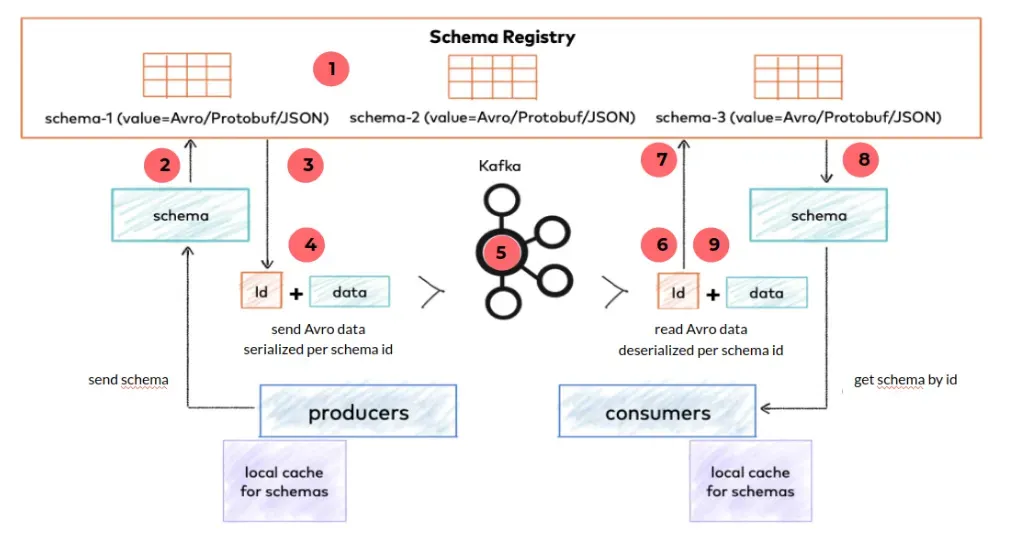
Consider using Event Schemas to ensure their evolution is handled in a versioned way. On the other hand, avoid schemas if the variation of the types of commands/events is small.
-
Consider Event Registries in advanced cases ( e.g. when the types of events are in hundreds and the number of consumers is very high). The highly decoupled nature of event-driven systems can sometimes lead to reduced traceability of dependencies and event data flow graph. Registries act like bookkeepers of publisher/consumer contracts. But like point 1 above, it’s an overkill for less complex systems.
-
Consider idempotency conditions, since Exactly Once semantics are not reliable. Kafka fans will tout its Exactly Once guarantees. However for critical processes involving financial or logistical systems, idempotency is a responsibility of the consumer systems. The CEO won’t be thrilled if double spending is commonplace, or if the same customer order is shipped twice.
-
Consider side effects of eventual consistency across systems. In more complex cases, the systems need to behave transactionally and/or atomically. In such cases, the likes of Saga Pattern or Outbox Pattern could be useful. For a non-trivial & multi-step transactionality, a central orchestrator with an async workflow is a better fit ( e.g. A complex Tax related workflow that combines automated, manual and batch operations). This opens the Pandora’s box of the BPM tools. Use them at your own risk.
-
Consider the eventuality of replaying events or commands— Sometimes systems reject events with incorrect acknowledgments and they may have to be re-sent. An event store that persists the event data and whether it succeeded or not could be useful. Most message brokers have this functionality built-in.
-
Consider pull vs push model of event handling. ( e.g. Kafka is pull-based, while GCP Pub/Sub provides both). Pull-based systems are good for more control & easy back-pressure configuration ( since the consumer dictates the rate of pulling messages), but it causes coupling between the broker and consumers, and a lot of onus falls upon the consumer.
Push-based brokers are more decoupled from consumers who only need to expose an API to the broker. But push-based systems need rate limiting for effective back pressure. This adds some complexity, and any 429s may be treated as errors.
In my experience, I have found the push-based model more reliable and robust.
-
Consider retrying with Exponential Back-offs and configuring Dead Letter Topics/Queues (DLQs) as a default practice. Also have intelligent retry jobs from DLQ.
This is a no-brainer in any non-trivial EDA system, especially those with high throughput.
-
Consider a business facing reporting functionality for the number of events received vs consumed vs failed. Most brokers provide this out of the box, along with alerting rules. In many cases a human intervention is imperative, and such reports are vital to make decisions. It saved our team’s time when we could present numbers to executives.
-
Explore the AsyncAPI standard for event driven APIs ( https://www.asyncapi.com). Although I haven’t been able to use it hands on, it looks promising with support for generating Specifications (like OpenAPI), Code generation, Documenting Events, Governance etc.
-
Evaluate the decision on the contents of your event payload with great deliberation. It’s a Type-1 decision and has caused me a great deal of pain. Balance between API chattiness and bulky events.
-
And lastly, YAGNI. Consider lightweight queuing mechanisms instead of Kafka or heavyweight brokers. You likely don’t operate at LinkedIn scale. ( e.g. Postgres, Redis, RabbitMQ etc. can act as suitable queues for many use cases) — Postgres as a Queue, Redis Pub/Sub
25-Oct-2024 EDIT: Avoid Redis Pub/Sub for applications needing strong guarantees of delivery.
These are some of the lessons I could recollect from my experience. I am sure there would be a lot more Whats and What-Nots. Hope this helps!